


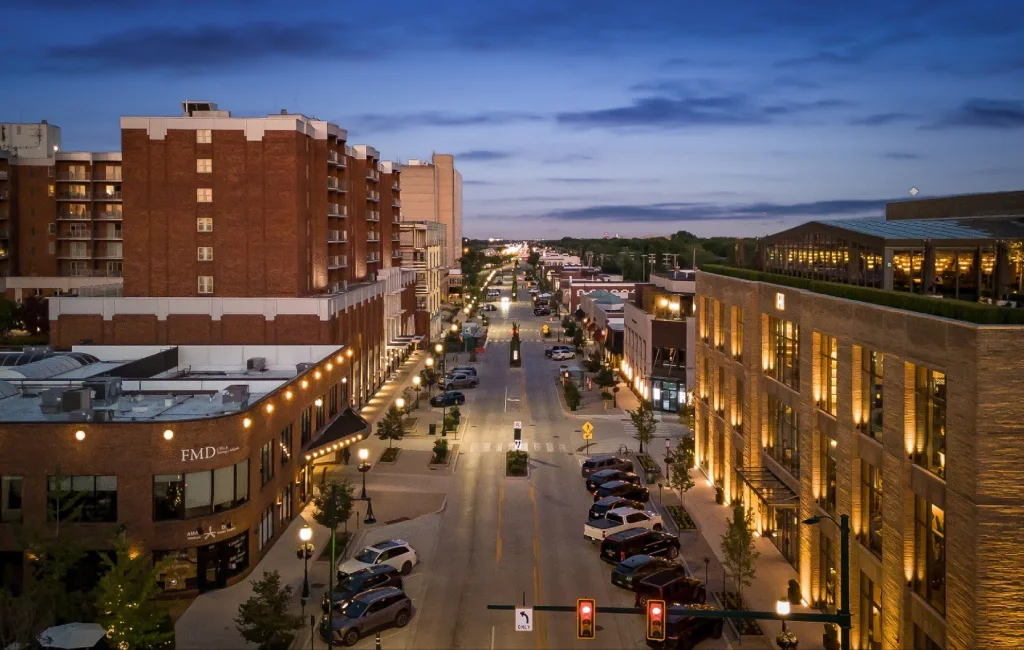
Imagine walking out your front door on a Friday morning, farmers market bag in one hand, coffee from a shop two blocks away in the other, and your kids already ahead of you on the sidewalk because school is close enough to walk. What if that wasn’t a fantasy version of suburban life but just a normal day?
Moving to Birmingham, Michigan, means choosing one of Metro Detroit’s most genuinely walkable, community-rooted, and academically strong suburbs, a city of roughly 20,000 people in Oakland County where tree-lined streets, historic homes, and a downtown that actually functions as a social center come together in a way that is rare in the Midwest. It is not cheap, and it is not right for everyone. But for the right buyer or family, it delivers a daily quality of life that holds up under honest scrutiny.
At DG Realty Group, affiliated with Signature Sotheby’s International Realty, we work with buyers and sellers across Oakland County and know Birmingham’s neighbourhoods, price dynamics, and seasonal realities from daily, active experience in this market.
Here is what this guide covers:
- What daily life actually looks and feels like in Birmingham, including an honest look at winter
- A neighbourhood-by-neighbourhood breakdown with real estate context for each area
- Current home prices, property taxes, and cost-of-living realities for 2026
- What families need to know about Birmingham Public Schools
- A direct Birmingham vs. Royal Oak comparison for anyone weighing both options
What Is It Actually Like to Live in Birmingham, Michigan?
Birmingham is a small city that feels larger than its population because of how much is packed into its walkable core. The residential streets are defined by mature tree canopy, front porches, and a neighbourhood scale that encourages walking and biking in a way that most Michigan suburbs do not. The downtown is not a commercial afterthought bolted onto a bedroom community; it is the social center of the city, and residents use it daily, not just on weekends. That distinction matters more than it sounds when you are evaluating where to spend the next decade of your life.
For relocators coming from true urban environments, Birmingham sits at a compelling midpoint: it offers the density of amenities that makes car-free errand-running possible, without the noise, density, or logistical friction of a major city. For those coming from purely car-dependent suburbs, it can feel like a meaningful upgrade in daily experience. The Walk Score for Birmingham’s downtown core is among the highest of any Detroit suburb, and that number reflects something real about how the city functions.
The Downtown Core Sets the Tone for the Whole City
Old Woodward Avenue anchors a retail and dining corridor that stretches through the heart of Birmingham and gives the city its identity. On a Sunday morning, the Birmingham Farmers Market operates at Public Parking Lot #6 (660 North Old Woodward Avenue) in the heart of downtown, with free parking and direct access to Old Woodward shopping and dining, pulling in residents from across the city for local produce, flowers, and the kind of sidewalk social scene that builds genuine neighborhood familiarity. Wine bars, independent boutiques, and restaurants ranging from casual to white-tablecloth sit within a few blocks of each other, and the programming at Shain Park runs year-round with community events that keep the park activated across seasons.
What makes the Old Woodward corridor unique among Oakland County suburbs is that it functions as the daily infrastructure of community life, not just a destination for special occasions. Residents bump into neighbors here. Kids know the shop owners. That social texture is not manufactured; it has developed over decades and is one of the hardest things to replicate when a city tries to build it from scratch.
Life Outside the Downtown Core Is Quiet but Still Connected
Beyond Old Woodward, Birmingham’s residential neighborhoods settle into a quieter register. Sidewalks run continuously through most of the city, mature trees arch over the streets, and the neighborhood scale stays human throughout. The Baldwin Public Library serves as a genuine community anchor; its programming for children, teens, and adults runs year-round and reflects a level of civic investment that residents notice and rely on.
Birmingham rewards engagement. People who move here and participate in the community, the parks, the events, the schools, and the block-level social life tend to stay. For buyers who value privacy or a quieter social footprint, it is helpful to understand that Birmingham has a strong sense of community and connection. That close-knit feel is part of the city’s appeal, and it is worth considering before you buy.
What Are the Best Neighbourhoods in Birmingham, MI?
Birmingham is small enough to walk across in an afternoon and varied enough that where you land within the city shapes your daily experience in meaningful ways. The four primary residential areas each attract a different buyer profile, and understanding those distinctions before you search is the difference between finding the right home and settling for the right city. In our experience working with buyers across Birmingham’s distinct neighborhoods, the question is rarely whether Birmingham is the right fit; it usually is, but which part of Birmingham matches how you actually want to live.
The table below gives a starting framework for each neighbourhood. All price ranges are approximate and should be verified against current MLS data before making any purchasing decisions.
| Neighborhood | Character | Typical Buyer Profile | Approx. Price Range |
| Quarton Lake Estates | Lakefront luxury, large lots, historic estates | Luxury buyers, move-up buyers, out-of-state relocators | $900K–$3M+ |
| Poppleton Park | Family-oriented, walkable to schools, and neighborhood cohesion | Families, buyers seeking community character | $600K–$1.1M |
| Booth Park Area | Quiet residential, park-adjacent, mid-century housing stock | Families, established buyers, long-term residents | $750K–$1.M+ |
| Downtown Periphery / South Birmingham | Walkable to Old Woodward, denser lots, mix of condos and smaller homes | Younger buyers, urban relocators, buyers prioritizing walkability over lot size | $500K–$1M |
What Does It Cost to Live in Birmingham, Michigan, in 2026?
Birmingham sits at the upper end of Metro Detroit’s suburban cost spectrum, and that reality deserves a direct accounting rather than the soft-pedalling that most relocation content offers. Home prices, property taxes, and the daily cost of dining and retail in the downtown core all reflect a community whose income demographics drive pricing across every category. Buyers relocating from major coastal metros often find Birmingham relatively affordable. Buyers arriving from other Michigan suburbs may experience genuine sticker shock.
The table below outlines what to expect across the primary cost categories. All figures are approximate and should be verified against current MLS data, Oakland County tax records, and local market sources before making financial decisions.
|
Cost Category |
What to Expect in Birmingham |
| Home Purchase (median range) | Approximately $650,000–$1,000,000+; luxury segment extends to $4M+ |
| Property Taxes (estimated) | Oakland County millage rates apply; high carrying cost on mid-range homes |
| Rental Market | Limited inventory; rental pricing reflects ownership market premium |
| Groceries and Dining | Above Michigan average; downtown dining reflects neighbourhood income demographics |
| Commute Costs | Minimal if a walkable location is selected; Detroit commuters should factor in Woodward corridor fuel or parking costs |
Home Prices Reflect a Market Where Demand Has Consistently Outpaced Supply
Median home prices in Birmingham have historically ranged from approximately $650,000 to $850,000, with the luxury segment in Quarton Lake Estates and comparable properties extending well above that ceiling. Days on market for desirable Birmingham properties have remained low relative to surrounding Oakland County suburbs; buyers entering this market should be prepared to act with purpose rather than treat showings as casual exploration.
New construction exists in Birmingham, but is limited by the city’s already-developed lot structure. Most buyers are purchasing renovated historic stock, which means condition, inspection history, and deferred maintenance carry outsized importance in the offer and due diligence process. A home that looks right at first glance may have structural or mechanical issues that significantly affect the true cost of ownership.
Property Taxes and Ongoing Costs Deserve Honest Attention
Oakland County millage rates apply in Birmingham, and property tax bills for mid-range Birmingham homes represent a meaningful line item in the monthly budget that buyers sometimes overlook when focused on the purchase price. The city’s investment in parks, infrastructure, public programming, and school facilities is part of what those taxes fund, and most long-term residents view the tax level as aligned with what they receive in return, but that perspective is easier to hold when you have planned for it from the start.
Buyers relocating from lower-tax states or counties should run the full carrying cost calculation- principal, interest, taxes, and insurance- before comparing Birmingham’s affordability against their current home. A purchase price that looks manageable can feel different once the monthly tax escrow is factored in. Oakland County tax records are publicly accessible, and your agent should pull the actual tax history on any property you are seriously considering.
What Do Families Need to Know About Birmingham Public Schools?
Birmingham Public Schools are one of the primary reasons families choose this city over nearby lower-cost alternatives, and it is worth understanding the district’s structure before you narrow your neighborhood search. The district serves Birmingham along with parts of several surrounding communities, and consistently ranks among the top public school districts in Michigan by academic performance metrics, a reputation that shows up directly in home values across every Birmingham neighborhood.
Birmingham’s private and independent school options, including nearby institutions in the Bloomfield corridor, give families additional flexibility, though most relocating families choose Birmingham specifically because the public option is strong enough that private school is a preference rather than a necessity. That distinction is part of why Birmingham’s home values carry the premium they do relative to neighboring communities with less consistent public school performance.
Birmingham vs. Royal Oak: Which One Actually Fits You?
Birmingham and Royal Oak sit less than 10 minutes apart, and if you are weighing both, you often assume the choice comes down to price alone. It doesn’t. The two cities serve genuinely different lifestyles, and the right answer depends on what you’re actually optimizing for.
Birmingham wins on:
- School district quality. Birmingham Public Schools consistently ranks among Michigan’s top public school districts statewide, well ahead of Royal Oak’s district, and for families with school-age children, this is often the deciding factor on its own.
- Neighborhood prestige and historic character. Birmingham’s residential streets, particularly around Quarton Lake Estates and Poppleton Park, offer an established, architecturally consistent character that Royal Oak’s more varied housing stock doesn’t replicate.
- A quieter, more polished daily texture. Old Woodward’s dining and retail scene leans toward the upscale and reserved rather than the loud or eclectic.
Royal Oak wins on:
- Price accessibility. Royal Oak’s median home price runs roughly $340,000 to $365,000 as of mid-2026, compared to Birmingham’s median well above $600,000, a gap substantial enough to change what buyers can afford in square footage, lot size, or renovation budget.
- Nightlife and dining energy. Royal Oak’s restaurant and bar scene is denser, younger, and more eclectic, with a walkable downtown that skews toward a livelier crowd.
- Urban density and younger buyer appeal. For buyers coming from larger cities, Royal Oak’s grittier, more urban feel can be a closer match to what they’re used to than Birmingham’s more polished suburban core.
The honest framing: if you have school-age children and can absorb the price premium, Birmingham is very likely the better long-term decision, and most families who make that trade-off don’t regret it. If you’re early in your career, budget-conscious, or prioritizing lifestyle-per-dollar in a walkable Metro Detroit suburb, Royal Oak is a legitimate, serious alternative, not a consolation prize. Buyers who treat this as a straightforward “better vs. worse” comparison usually haven’t spent enough time in both cities; buyers who treat it as a fit question almost always land on the right answer for their situation.
Why DG Realty Group Is the Right Partner for Your Birmingham Move
Choosing the right agent in a market as competitive as Birmingham is not a minor decision. DG Realty Group, affiliated with Signature Sotheby’s International Realty, brings active Oakland County experience and global marketing reach to every transaction, a combination that serves buyers and sellers in ways a local-only agent cannot. Here is what sets the team apart:
- Signature Sotheby’s global network. Your property or search reaches luxury buyers well beyond Michigan, a real advantage in Birmingham’s upper price segments, where out-of-state and international buyers are a consistent part of the market.
- Active Birmingham and Oakland County presence. The team tracks inventory, days on market, and price movement daily, so your guidance is current and grounded, not generalized.
- Full buyer and seller representation. Whether you are buying in Poppleton Park or selling in Quarton Lake Estates, you get full attention on your side of the transaction.
- Honest cross-market perspective. We know how Birmingham compares to Royal Oak, Bloomfield Hills, Northville, and Troy, and will tell you which market actually fits your situation.
- Transparent process post-2024 NAR settlement. Every buyer is guided through written representation requirements with no surprises and no ambiguity.
- Relocation support for out-of-state buyers. Neighborhood context, school boundaries, commute realities, and carrying cost calculations, not just a property list.
DG Realty Group operates under the Signature Sotheby’s umbrella, a brand that holds its agents to production thresholds and professional standards that not every Michigan agent meets.
Frequently Asked Questions
Q: What is the cost of living in Birmingham, Michigan, compared to other Detroit suburbs?
Birmingham sits at the higher end of Metro Detroit’s suburban cost spectrum, meaningfully above comparable options in Royal Oak, Troy, or Rochester. Property taxes in Oakland County add to the monthly carrying cost, and dining and retail in downtown Birmingham reflect the community’s income demographics, so day-to-day expenses tend to run higher than in surrounding suburbs. Buyers relocating from major coastal metros often find Birmingham relatively affordable by comparison; those coming from other Michigan communities may experience genuine sticker shock.
Q: Is Birmingham, Michigan, a good place to raise a family?
For families prioritizing school quality, neighborhood safety, and walkable community character, Birmingham ranks among the strongest options in all of Southeast Michigan. Birmingham Public Schools consistently places in the top tier of Michigan districts by academic performance metrics, and the city’s parks system, Baldwin Public Library programming, and dense calendar of youth activities give families a rich ecosystem within walking distance of most residential neighborhoods. Birmingham’s home values reflect the continued demand from families who see lasting value in exactly this combination of location, lifestyle, schools, and community.
Q: How far is Birmingham from Downtown Detroit, and how is the commute?
Birmingham is located approximately 20 miles north of Downtown Detroit via the Woodward Avenue corridor, with a typical drive time of 30 to 45 minutes, depending on the time of day. Woodward is a signalized boulevard rather than a freeway, which means commute times are more variable than on a pure highway route and more sensitive to peak-hour conditions than mileage alone suggests. Many Birmingham residents now work hybrid or fully remote schedules, and the city’s downtown walkability means some residents rarely need to drive on workdays at all, a shift that has become a meaningful part of Birmingham’s appeal for post-pandemic relocators.
Q: What are the best neighbourhoods in Birmingham, MI, for different buyer types?
Quarton Lake Estates is Birmingham’s most prestigious and highest-priced neighbourhood, suited to luxury buyers seeking lakefront access, estate-scale properties, and historic architectural character at the top of the market. Poppleton Park attracts families drawn to its proximity to schools and Booth Park, its neighbourhood cohesion, and home prices that are meaningfully more accessible than Quarton Lake while still reflecting Birmingham’s premium over surrounding suburbs. The downtown periphery and South Birmingham neighbourhoods appeal to buyers who prioritize walkability to Old Woodward dining and retail above lot size, and tend to skew toward younger buyers and those relocating from urban environments. Each neighborhood requires a different buying strategy, inventory is limited, and competition is consistent across all of them.
Q: Is it worth moving to Birmingham, Michigan, instead of Royal Oak?
The answer depends almost entirely on your priorities, and both cities deserve an honest assessment rather than a reflexive ranking. Birmingham leads in school district quality, neighbourhood prestige, historic character, and community cohesion for families with school-age children who can absorb the price premium; Birmingham Public Schools alone often justifies the cost difference. Royal Oak wins on price accessibility, a more eclectic and energetic dining and nightlife scene, and an urban density that resonates with younger buyers or those coming from larger cities. If you are early in your career, budget-constrained, or primarily motivated by lifestyle per dollar in a walkable Metro Detroit suburb, Royal Oak is a serious, legitimate alternative that deserves genuine consideration alongside Birmingham.
Conclusion
Birmingham, Michigan, delivers something genuinely rare in the Midwest: a walkable downtown with real daily utility, a top-performing public school district, historic neighborhood character, and a community culture that keeps long-term residents. That combination commands a real price premium, and buyers who understand why rarely feel they overpaid.
Quarton Lake Estates, Poppleton Park, South Birmingham, and the downtown periphery each offer a meaningfully different version of life here. Matching yourself to the right segment before you buy matters more than most relocators anticipate, and the most desirable properties across every price band move quickly. Preparation is the practical difference between finding your home and watching someone else close on it.
DG Realty Group, based at 415 South Old Woodward Avenue in Birmingham, MI, is ready to help. Reach out to the DG Realty team to schedule a private consultation, and let them plan a weekend tour that fits right around your favorite table.