

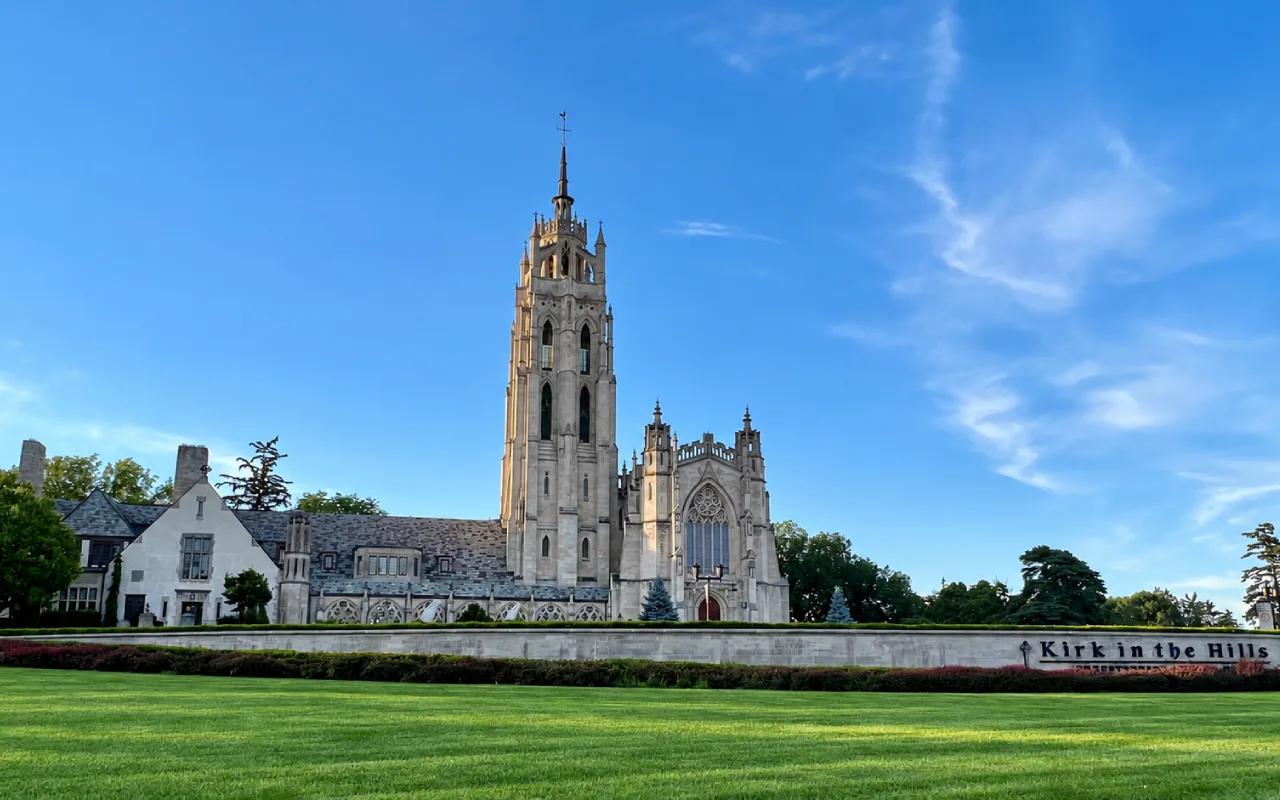
Some places in Michigan stop you mid-sentence. You are trying to describe them to someone who has never been there, and the words you reach for (beautiful, peaceful, remarkable) feel too small. Kirk in the Hills in Bloomfield Hills is one of those places.
Kirk in the Hills is a Gothic-style Presbyterian church and landmark situated on 40 acres of lakeside grounds along West Long Lake Road in Bloomfield Township, within the Bloomfield Hills postal area, Oakland County.
Modeled after the 13th-century Melrose Abbey in Scotland, it was built between 1951 and 1958 on land gifted by the estate of Colonel Edwin S. George. It is one of the most architecturally significant religious landmarks in Metro Detroit and one of the most compelling reasons why Bloomfield Hills feels like nowhere else in Michigan.
At DG Realty Group, Dan Gutfreund and the team help buyers and sellers understand what makes Bloomfield Hills worth knowing, and Kirk in the Hills is a place every serious buyer in this market should see for themselves.
Here is what this guide covers:
- The full history of Kirk in the Hills, from the 1947 estate gift through the first service in 1958
- The architectural details that make this Gothic church unlike anything else in the state
- The 40-acre lakeside gardens and outdoor setting that define the visitor experience across every season
- What to know before you visit, including services, community life, and how the church welcomes the public
- Why Kirk in the Hills matters to anyone drawn to Bloomfield Hills as a place to live
What Is Kirk in the Hills, and Why Does It Matter to Bloomfield Hills?
Kirk in the Hills sits on West Long Lake Road in Bloomfield Township, along the edge of Island Lake in Oakland County, roughly 20 miles northwest of downtown Detroit. It is a Presbyterian church of Gothic design occupying a 40-acre lakeside estate, and it is the kind of landmark that earns its name in a community. The building is not hidden or tucked away. It announces itself through the scale of its stonework, the height of its towers, and the stillness of the grounds surrounding it.
For anyone researching Bloomfield Hills as a destination or as a potential home, Kirk in the Hills serves as one of the clearest signals of what this community values: permanence, craft, beauty maintained over generations, and institutions that take their role in the landscape seriously. This is not background scenery. It is a defining feature of the place.
A Church That Defines Its Neighborhood
Kirk in the Hills functions the way only a truly rooted institution can, as a marker of what the community around it believes and how it presents itself to the world. For long-term residents, it is part of the fabric of daily life in Bloomfield Hills, as natural to the landscape as the mature trees lining the roads and the lakes visible from almost every corner of the township. You drive past it on an ordinary Tuesday, and it still registers as something worth looking at.
For newcomers and buyers exploring the area for the first time, Kirk in the Hills is often the moment of recognition. It is the sight that confirms this is a different kind of place, one where the investment in beauty and permanence runs deep and has been running for a long time. That recognition matters, because it is not manufactured. It is the result of decisions made decades ago and maintained ever since.
Where It Sits: Island Lake, West Long Lake Road, and the Bloomfield Hills Setting
The church’s address on West Long Lake Road places it along one of the most quietly beautiful residential corridors in all of Oakland County, bordered by water, mature hardwoods, and properties that reflect the same long-term investment in quality that the church itself embodies. Island Lake is the body of water that gives the grounds their lakeside character, and its presence shapes the way the building and gardens feel from both inside and outside the property boundary.
This is not a church situated next to a strip mall or visible from a commercial intersection. The setting is inseparable from the experience. You arrive by moving through a residential landscape that has been left largely intact, and the transition from road to grounds to building is itself a form of architecture, a designed approach that many visitors notice without fully understanding why.
For a full picture of the Bloomfield Hills area and what surrounds Kirk in the Hills, the Oakland County website’s community profiles offer a reliable starting point for geographic and civic context.
How Did Kirk in the Hills Come to Be? The History Behind the Landmark
The founding of Kirk in the Hills begins not with a congregation or a construction crew, but with a gift.
In 1947, the estate of Colonel Edwin S. George donated the lakeside property along West Long Lake Road to the Presbyterian congregation that would eventually build the church. That gift, a 40-acre lakeside estate of scale and natural beauty, made possible the ambition of what followed. Without it, neither the building nor the grounds as they exist today would have been achievable.
The cornerstone was laid in 1951, beginning a construction process that stretched longer than expected. A fire damaged the structure during building, a setback that delayed completion by a meaningful period but did not alter the congregation’s design intentions. The first service was held in November 1958, marking the completion of a project that had taken more than a decade from gift to consecration. The result was a building of exceptional scale and craft that remains, decades later, one of the most significant postwar religious structures in Michigan.
Timeline: Kirk in the Hills, From Gift to First Service
| Year | Milestone |
| 1947 | Colonel Edwin S. George estate donates the lakeside property |
| 1951 | Cornerstone laid; construction begins |
| 1950s (mid) | Construction fire damages structure; completion delayed |
| November 1958 | First service held; building consecrated |
Colonel Edwin S. George and the Gift That Started Everything
Colonel Edwin S. George was the donor whose estate provided the physical foundation for what would become one of Michigan’s most celebrated historic religious sites. His 1947 gift of lakeside land was not a modest contribution. It was a 40-acre estate with the kind of natural setting that made the eventual scale and design of the church possible in a way that no purchased urban or suburban lot could have replicated.
The gift matters because it shaped everything that followed. A congregation with different land, flatter, smaller, further from water, would have built a different church. The lakeside setting along Island Lake, the natural boundary the water provides, the way the grounds extend the architectural experience outward from the building, all of this traces directly back to what Colonel George’s estate made available. Understanding the donor is understanding the origin of the place.
For those researching Michigan’s history of significant private land donations and their role in shaping the state’s architectural and institutional landscape, the Michigan History Center maintains accessible records and resources.
From Cornerstone to Consecration: The Building Timeline
The cornerstone laid in 1951 marked the beginning of a construction process that carried real ambition and real difficulty. The design demanded stonework, sculpted details, stained glass, and structural decisions that were already becoming rare in American religious architecture by the mid-20th century. That ambition had a cost in time and in setbacks, most notably the construction fire that damaged the building and extended the timeline beyond original projections.
The first service held in November 1958 was not simply an opening. It was a resolution. The congregation had sustained a project through a fire, through years of construction, and through the challenge of realizing a design rooted in 13th-century Gothic tradition in postwar suburban Michigan. What they completed was a building that belonged to its landscape and to its time in equal measure.
What Makes the Architecture of Kirk in the Hills So Distinctive?
The architecture of Kirk in the Hills is distinctive for reasons that go well beyond the obvious visual impression. Yes, the stonework is striking. Yes, the towers command the skyline above the surrounding landscape. But the building earns its reputation through specific decisions: the Melrose Abbey inspiration, the stained glass windows, the stonework architecture carried through both exterior and interior, and structural choices that were unusual even at the time of construction.
- Gothic pointed arches throughout the nave and exterior openings, derived directly from medieval ecclesiastical design
- Stained glass windows composing a full program of light and color that reads differently depending on the time of day and the season
- Stonework and sculptures on the exterior and interior reflecting a level of craft that was already becoming economically rare in 1950s American construction
- Exposed aggregate concrete as a primary structural material, a trade-significant choice that gives the building its particular weight and texture while remaining largely invisible to casual visitors
- Elevated walkway, interior balcony, and stairwell configurations that create a vertical spatial drama uncommon in American churches of this era
- Cathedral-style proportions in the nave that work with the acoustic properties of the stone construction to create a space suited to formal choral and organ performance
The Melrose Abbey Inspiration and What It Means for the Design
Melrose Abbey is a ruined 13th-century Gothic monastery in the Scottish Borders, and it provided the direct design inspiration for Kirk in the Hills, meaning the architects reached across centuries and an ocean to bring a specifically Scottish Presbyterian architectural tradition to Bloomfield Township. That is not a superficial stylistic choice. It is a statement about what the congregation believed a church should look and feel like.
The Melrose Abbey connection is visible in the pointed arches, the heavy stone construction, the sense of verticality, and the way light enters the building through narrow, deeply set windows. These are design principles that originate in medieval ecclesiastical architecture and that were refined over centuries before being translated into a mid-20th-century Michigan setting.
Stained Glass, Stonework, and the Details That Reward a Closer Look
The stained glass and stonework at Kirk in the Hills are the two most visually compelling elements of the building, and both reward the kind of slow, sustained attention that a single visit may not fully allow. The stained glass windows compose a program of imagery and color that changes as the light shifts. What you see in the morning is not what you see in the afternoon, and what you see in winter is not what you see in June. Photographs capture a moment of this. They do not capture the full range.
The stonework throughout the exterior and interior reflects a commitment to craft that was unusual even for the 1950s, when large-scale decorative stonework in American religious buildings was already becoming economically uncommon. The decision to pursue it here, at this scale, signals how seriously the congregation and its donors took the building’s long-term identity.
The use of exposed aggregate concrete as a primary structural material is a detail almost entirely invisible to casual visitors but significant to anyone with an interest in mid-century construction methods. It gives the building its particular density and texture (the sense that the walls have mass and permanence) while remaining concealed beneath the stone finish that defines the visual experience.
Interior Spaces Worth Knowing: Elevated Walkways, Balconies, and the Narthex
Inside Kirk in the Hills, the spatial experience is defined by height, weight, and the awareness of the space above you. The elevated walkway, interior balcony, and stairwell configurations give the building a vertical drama that is uncommon in American churches of its era. You move through spaces that consistently remind you of their own scale, and that sense of scale is not accidental. It is designed.
The narthex, the formal entryway between the exterior and the nave, is architecturally significant as a transitional space, marking the threshold between the everyday world outside and the sanctuary within. Most visitors pass through it quickly on their way to the sanctuary, but it sets the tone for everything that follows. The narthex at Kirk in the Hills is not simply a lobby. It is the beginning of the architectural experience, not an afterthought to it.
These interior details are not accessible to a visitor who remains outside the building, and they are not described in most existing coverage of Kirk in the Hills. They are part of what makes an actual visit, particularly during a service or an arranged architectural tour, worth planning for rather than treating as a casual stop.
Why DG Realty Group Is the Right Partner for Bloomfield Hills and Metro Detroit
Bloomfield Hills is not a market where surface-level knowledge gets buyers and sellers where they need to go. The communities along West Long Lake Road, throughout Bloomfield Township, and across Oakland County have their own character, their own history, and their own standards, and the agent you work with should understand all of that before the first conversation about square footage or list price. DG Realty Group, led by Dan Gutfreund, Senior Global Real Estate Advisor with Signature Sotheby’s International Realty, is built around exactly that kind of place-based knowledge, and the “I Sell Michigan” brand reflects a genuine commitment to understanding what Michigan communities are, not just where they are on a map.
| What We Offer | What It Means for You |
| Michigan-focused market knowledge | You work with an agent who understands Bloomfield Hills, Bloomfield Township, and Oakland County at the neighborhood level, not just the listing level |
| Statewide reach under one brand | Whether you are relocating from across Michigan or coming from outside the state, DG Realty Group knows the terrain and can serve you across markets |
| Buyer and seller representation | You get full-service support on either side of the transaction, from pricing and listing strategy to offer evaluation and negotiation |
| Place-first approach to every client conversation | Community character, architectural heritage, school districts, and daily lifestyle are part of every conversation from the start, not afterthoughts |
| Michigan-proud brand identity | The “I Sell Michigan” name is not a marketing line. It reflects an agent who has invested in understanding what makes Michigan worth living in |
DG Realty Group, led by Dan Gutfreund and operating under Signature Sotheby’s International Realty, serves buyers and sellers with deep familiarity in the Oakland County and Metro Detroit markets where communities like Bloomfield Hills define what Michigan residential real estate looks like at its most distinctive. Dan Gutfreund is a Senior Global Real Estate Advisor recognized as the #1 Agent in Michigan for Individual Sales by RealTrends and The Wall Street Journal (2023) and ranked among Sotheby’s International Realty’s Top 100 agents globally (2024-2026), with more than $800 million in career sales.
Frequently Asked Questions
Who built Kirk in the Hills, and where did the land come from?
Kirk in the Hills was built by a Presbyterian congregation in the Bloomfield Hills area on land gifted by the estate of Colonel Edwin S. George in 1947, providing the 40-acre lakeside property along West Long Lake Road that made the church’s architectural ambitions possible. The cornerstone was laid in 1951, and the first service was held in November 1958 after a construction fire caused delays during the building process.
What is Kirk in the Hills modeled after?
Kirk in the Hills was designed in the style of Melrose Abbey, a ruined 13th-century Gothic monastery in the Scottish Borders, reflecting the Scottish Presbyterian heritage of the congregation. The inspiration is visible throughout the building in its pointed arches, heavy stonework, vertical proportions, and the way natural light enters through deeply set windows, design principles drawn directly from medieval ecclesiastical architecture.
Is Kirk in the Hills open to visitors, or is it members only?
Kirk in the Hills is a functioning Presbyterian congregation rather than a publicly managed historic site, so interior access is generally available through scheduled services and special events rather than as a walk-in destination. The grounds and exterior are widely understood to be accessible to respectful visitors who want to experience the architecture and landscaping, though anyone planning a visit specifically to see the interior stained glass or stonework should verify current access policies with the church directly before making the trip.
How long did it take to build Kirk in the Hills?
From the laying of the cornerstone in 1951 to the first service in November 1958, construction took approximately seven years, with the timeline extended by a fire that damaged the structure during the building process. The fire was a significant setback but did not reduce the congregation’s design ambitions, and the completed building remains one of the most fully realized Gothic-style church buildings constructed in the United States during the postwar period.
What makes Kirk in the Hills different from other Michigan churches?
Several things distinguish Kirk in the Hills within Michigan’s religious and architectural landscape: its direct design inspiration from a specific 13th-century Scottish landmark, its 40-acre lakeside setting on Island Lake, the stained glass program and decorative stonework throughout the interior and exterior, and the use of exposed aggregate concrete as a primary structural material. It was also completed in 1958, making it one of the last ambitious Gothic-revival church buildings finished in the region at a moment when that architectural tradition was already becoming rare in American religious construction.
Conclusion
Three things are worth holding onto from what you have read here. Kirk in the Hills is a Gothic landmark modeled on a 13th-century Scottish abbey, built on a 40-acre lakeside estate gifted in 1947 and completed after seven years of construction in 1958, a timeline that reflects both the scale of what the congregation set out to build and the commitment it took to see it through. The building’s stained glass, stonework, lakeside grounds, and cathedral-scale interior make it one of the most architecturally complete religious landmarks in Metro Detroit, and one that no single photograph adequately prepares you for. And Kirk in the Hills is not a relic. It is a living congregation with an active music program, a welcoming community, and grounds maintained to a standard that reflects everything Bloomfield Hills consistently produces and preserves.
Landmarks like this one do not appear by accident. They exist in communities that have made long-term investments in beauty, craft, and institutional character, and Bloomfield Hills is that kind of community throughout, not just here.
If you are beginning to wonder what it would mean to live in a neighborhood where a place like Kirk in the Hills is part of the ordinary Sunday morning, Dan Gutfreund and the DG Realty Group team are ready to have that conversation. We know Bloomfield Hills, Oakland County, and the Metro Detroit market at the level of community and neighborhood, not just square footage and list price. Visit us at isellmichigan.com, or reach the team directly at (248) 497-4646 or [email protected], to start exploring what Michigan has for you.