

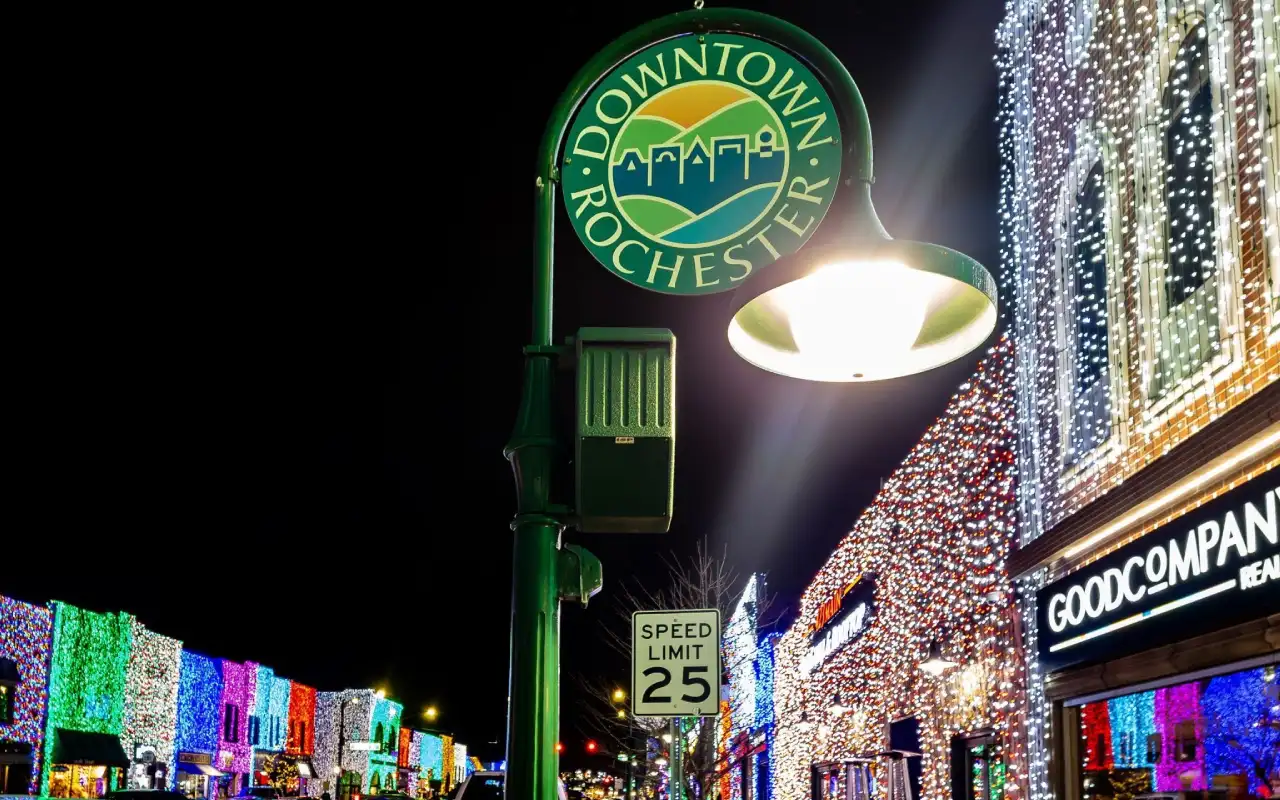
What if the neighborhood you have been searching for already exists, a walkable Main Street, trails along the water, independent shops, and a community that shows up for each other every season of the year?
Downtown Rochester, Michigan, is one of Oakland County’s most distinctive small-city downtowns. It is a compact, walkable corridor anchored by historic downtown Rochester Michigan Main Street, lined with independently owned businesses, and connected to some of the best trail access in Metro Detroit. If you have been evaluating communities in this part of Michigan, Rochester deserves a close look, not just as a place to visit, but as a place to actually live.
At DG Realty Group, we work with buyers and sellers across Michigan, and downtown Rochester is a community we return to again and again, because it genuinely delivers on what people say they are looking for.
Here is what this guide covers:
- The history and architectural character that makes Rochester’s downtown feel different from any other suburban corridor in Oakland County
- Where to shop, eat, and spend a morning without running out of reasons to stay longer
- The trail system connecting Paint Creek and the Clinton River to the heart of downtown
- Seasonal events and community traditions that define Rochester’s year-round identity
- Nearby destinations that make Rochester a natural anchor point for exploring northern Metro Detroit
What Makes Downtown Rochester, Michigan Worth Your Time?
A Guide to Downtown Rochester starts with a simple fact: this is not a typical suburban commercial corridor. While most Oakland County strip-mall and lifestyle-center developments are dominated by national chains, downtown Rochester operates differently. Approximately 85% of downtown businesses are independently owned, and more than 350 to 400 businesses operate within the district, spanning retail, dining, wellness, professional services, and personal care. That level of independent ownership is not common in Metro Detroit, and it is the single strongest signal that this place has a genuine local identity rather than a franchised one.
The result is a streetscape that changes, evolves, and reflects the decisions of people who actually live and work here. When a new shop opens or a restaurant changes its menu, it is because a local owner made that call. That texture is what visitors notice first and what residents come to depend on.
Why it matters: An independently owned downtown is not just more interesting to walk through, it tends to be more resilient, more community-connected, and more reflective of the people who call the surrounding neighborhoods home.
Rochester Sits at a Distinctive Point in Oakland County’s Geography
Rochester is approximately 25 miles north of Detroit, accessible via I-75 and M-59, with typical drive times from downtown Detroit running roughly 35 to 45 minutes depending on traffic. For buyers considering the broader northern Oakland County market, Rochester’s position matters: it sits within easy reach of Auburn Hills, Troy Michigan, and Pontiac, making it a practical anchor for anyone evaluating the region.
It is also worth clarifying upfront that Rochester and Rochester Hills are separate, independently incorporated municipalities. They share a border and some infrastructure, but they have distinct identities, distinct governance, and distinct real estate markets. When you are researching this area, keeping that distinction clear will save you confusion, and it is something buyers frequently ask about when they first start looking here.
What Does the Historic Architecture of Downtown Rochester Tell You About the Place?
The 19th-century architecture and historic buildings in downtown Rochester are not preserved as a theme, they survived because the community chose to maintain them.
Walking Main Street, you encounter commercial facades built to a human scale, with ground-floor storefronts designed to invite pedestrians rather than funnel traffic. That is not an accident of aesthetics; it is the physical record of a town that grew organically and has been careful about what it allowed to replace what came before.
For anyone evaluating Rochester as a place to live, this matters beyond the visual appeal. Preserved historic streetscapes tend to reflect long-term community investment in the character of a place, a signal that residents and local government have cared consistently about what downtown looks and feels like. That kind of continuity is harder to manufacture than it looks, and most suburban corridors have already lost it. For further context on Michigan’s historic preservation programs, Michigan State Historic Preservation Office offers detailed documentation on districts and registered properties statewide.
Several 19th-Century Structures Remain Standing and in Active Use
Several named buildings anchor the historic character of Main Street and give Rochester’s streetscape a depth of documentation that most suburban downtowns cannot match. The Western Knitting Mills building represents Rochester’s industrial heritage, a conversion from manufacturing to contemporary use that reflects the area’s economic evolution over more than a century. The Opera House Building and the Rollin Sprague Building are frequently cited examples of the commercial architecture that defined Main Street in Rochester’s early development period. The Lewis Ward Curtis Building adds another layer to the preserved streetscape.
Where Do Locals Shop in Downtown Rochester, Michigan?
The walkable boutique shopping district Oakland County has one of the most cohesive retail identities in the region, and it is worth understanding what kind of shopping experience you are actually walking into. Downtown Rochester is not an everyday convenience retail corridor. You will not find a Target or a Walgreens anchoring the block. What you will find is a high density of specialty, gift-oriented, and curated retail, home goods, apparel, books, art, locally made products, and lifestyle items that reflect the decisions of independent owners rather than national buyers.
That distinction shapes the experience entirely. Browsing is the primary mode here. Visitors regularly describe spending two to three hours covering a few blocks without running out of discoveries, which speaks both to the density of the retail and to the quality of individual storefronts. For buyers considering what daily life near downtown Rochester would actually look like, this kind of walkable commercial district is one of the assets most consistently mentioned in relocation conversations. The Rochester Downtown Development Authority maintains a current business directory for anyone who wants to research specific shops before visiting.
Boutique Retail and Specialty Shops Anchor the Main Street Corridor
The retail mix skews toward discovery shopping rather than errand shopping. Home goods, apparel, books, art, and curated lifestyle products are well represented throughout the district. Many independent retailers in downtown Rochester have operated for a decade or more, which signals both the stability of foot traffic and the loyalty of the local customer base, two things that do not happen by accident in a retail corridor.
Shopping categories currently represented in downtown Rochester include specialty gift shops, independent bookstores, apparel and accessories boutiques, home décor and furnishings retailers, art galleries, toy and children’s specialty shops, and stationery and paper goods stores. This range means that a single visit can serve multiple purposes, which is part of why the district retains shoppers for extended periods rather than producing quick transactional stops.
What Is the Dining Scene Like in Downtown Rochester, MI?
Local dining and cafes in downtown Rochester cover a wide enough range to serve both a weekday lunch regular and a Saturday evening reservation, and the fact that most of it is independently owned means the menus reflect actual culinary decisions rather than corporate standardization. Rochester’s food scene is one of the lifestyle assets buyers most frequently cite when describing why they chose this area, and it holds up across the full spectrum from coffee shop to white tablecloth.
The Downtown Rochester Michigan DDA dining directory is a practical resource for confirming current operating restaurants and hours before planning a visit.
Upscale and Award-Winning Options Make Rochester a Dinner Destination
Several restaurants in or immediately adjacent to downtown Rochester have received recognition from regional food publications and dining guides. The Royal Park Hotel, situated along the Clinton River near downtown, anchors a fine-dining tier and functions as a gathering point for special occasions and out-of-town visitors. Its location along the water adds an atmosphere that most inland restaurant settings cannot replicate.
The proximity of upscale dining to the trail system and Main Street retail means Rochester can reasonably serve as a full-day or evening outing rather than a quick stop. That range, from morning coffee to a dinner reservation, all within walking distance, is part of what distinguishes Rochester from downtowns that do one end of the spectrum well but not both.
What Outdoor Recreation Does Downtown Rochester Offer?
The Paint Creek and Clinton River trails downtown give Rochester something most suburban downtowns cannot offer: the ability to step off Main Street and onto a multi-mile trail system without driving anywhere first. That kind of direct trail access from the heart of a commercial district is rare in Oakland County, and it is one of the features buyers in this market consistently identify as a genuine quality-of-life differentiator.
| Trail | Key Facts |
| Paint Creek Trail | Approx. 8.9 miles, Rochester to Lake Orion; paved/improved surface, accessible for walking, jogging, cycling |
| Clinton River Trail | Connects Rochester to a broader regional trail network; river corridor with green space along water’s edge |
For current trail conditions, maps, and access points, the Paint Creek Trail Commission maintains updated information for both local users and visitors planning a first visit.
Paint Creek Trail Connects Downtown Rochester to the Surrounding Landscape
Paint Creek Trail runs approximately 8.9 miles from downtown Rochester northward to Lake Orion, following the Paint Creek corridor through a mix of natural and residential landscapes. The trail is paved or improved-surface for most of its length, making it accessible for cyclists, walkers, and joggers across a wide range of fitness levels and ages.
Downtown access to the trail is one of the practical amenities that buyers in this area consistently identify when describing what drew them to Rochester. The ability to walk from your front door to a multi-mile natural trail corridor without loading a car is a genuine lifestyle asset, the kind that is easy to describe in a listing and easy to experience once you live here. For buyers coming from urban environments where trail access is built into neighborhoods by design, Rochester’s trail connectivity will feel immediately familiar. For buyers coming from more car-dependent suburban settings, it often registers as one of the more significant quality-of-life upgrades the area offers.
The Clinton River Trail and Green Space Extend the Outdoor Network
The Clinton River Trail provides a complementary route that connects Rochester to the broader regional trail network. The river corridor itself creates a band of green space along the water’s edge that adds a natural buffer to the otherwise urban downtown environment, one of the features that gives Rochester its distinctive hybrid character: small-city energy with natural access woven through it.
Dinosaur Hill Nature Preserve offers a family-oriented outdoor destination within close proximity to downtown, with trails through a wooded natural area that functions as a local retreat distinct from the paved trail network. Where the Paint Creek and Clinton River trails serve the runner, the cyclist, and the commuter, Dinosaur Hill serves the family with young children, the naturalist, and the resident who wants to spend an hour in the woods without leaving their neighborhood. That range of outdoor options, paved trails, river greenway, and preserved natural areas, is part of what makes Rochester’s outdoor recreation cluster genuinely broad rather than just deep on a single asset.
What Seasonal Events Define the Downtown Rochester Calendar?
Rochester’s Big Bright Light Show, its farmers market, and its community festivals give the district a year-round rhythm that most suburban corridors cannot sustain. The events calendar here is not a collection of one-off activations, it reflects a community that has built consistent traditions over years and shows up to maintain them. For prospective residents, that kind of consistent community investment in shared public experience is one of the harder things to quantify and one of the easier things to feel once you are here.
| Season | Signature Event or Activity | What to Expect |
| Spring | Farmers Market opening, Paint Creek Trail season | Market vendors return; trail foot traffic picks up; outdoor dining begins |
| Summer | Seasonal festivals, arts events, outdoor dining | Community celebrations, evening events on Main Street |
| Fall | Yates Cider Mill visits, harvest events, market closing | Regional draw for fall rituals; community gatherings |
| Winter | Big Bright Light Show, Lagniappe kickoff celebration | Rochester’s most recognized annual tradition; draws Metro Detroit visitors |
The Rochester Downtown Development Authority publishes a current events calendar with dates, organizers, and access information for each season.
The Big Bright Light Show Is Rochester’s Most Recognized Annual Tradition
The Big Bright Light Show typically runs from late November through mid-January along Main Street and surrounding downtown blocks. The display is recognized as one of the more elaborate municipal holiday lighting installations in Michigan, drawing visitors from across Metro Detroit who make it an annual household tradition.
For families evaluating Rochester as a place to live, this kind of signature community event carries real weight in the decision. It signals that the community invests in its public spaces and shared traditions, that residents here do not just coexist, they show up. That is the kind of detail that appears in relocation conversations, not because someone put it in a brochure, but because people who live here bring it up unprompted when they talk about why they chose this neighborhood.
What Day Trips and Nearby Destinations Are Within Reach of Downtown Rochester?
Rochester’s position in northern Oakland County places it within easy reach of some of the strongest cultural and seasonal destinations in the day trip destination Metro Detroit Rochester MI orbit. For buyers evaluating the area, this matters in two directions: it makes Rochester attractive as a base for regional exploration, and it means the lifestyle assets available to Rochester residents extend well beyond the city limits.
| Destination | Distance / Drive Time from Downtown Rochester | Best For |
| Meadow Brook Hall | Under 15 minutes | Historic house museum, seasonal tours, special events |
| Rochester Hills Museum at Van Hoosen Farm | Under 15 minutes | Local history, agricultural heritage, family visits |
| Yates Cider Mill | Under 20 minutes | Fall cider and donuts, Clinton River connection, seasonal family tradition |
| Dinosaur Hill Nature Preserve | Within Rochester; walkable or short drive | Trails, natural area, year-round access |
Meadow Brook Hall and Van Hoosen Farm Anchor the Cultural Tier
Meadow Brook Hall, located on the campus of Oakland University in adjacent Rochester Hills, is one of the largest historic house museums in the United States and a National Historic Landmark. Its scale and architectural ambition, a Tudor Revival manor house built in the late 1920s, make it a regional landmark that most Metro Detroit residents know by name even if they have not visited. For buyers relocating from outside Michigan, it is the kind of destination that reframes how they think about what is available in this part of the state.
The Rochester Hills Museum at Van Hoosen Farm offers a more intimate look at the agricultural and domestic history of this part of Oakland County. Both destinations are accessible from downtown Rochester in under 15 minutes, making them natural extensions of a day that starts on Main Street and builds outward from there.
Yates Cider Mill Is a Fall Institution for the Whole Region
Yates Cider Mill is one of the oldest continually operating cider mills in Michigan and draws visitors from across Metro Detroit during the fall season. Its location along the Clinton River in nearby Rochester Hills places it in the natural geographic orbit of Rochester’s trail system; some visitors combine a trail walk with a cider mill stop as a single outing, which is the kind of afternoon that becomes a household ritual after the first time you do it.
For buyers evaluating the Rochester area, the presence of Yates Cider Mill within easy reach represents the kind of seasonal anchor that shapes how a family actually spends its weekends in October. These details are hard to quantify in a home search, but they are easy to value once you are looking for them. Rochester has an unusually high density of them, and that density is part of what makes this area worth understanding before you decide where in Michigan you want to plant roots.
Rochester Offers a Small-City Scale That Larger Downtowns Cannot Replicate
Rochester’s Main Street corridor is compact enough that visitors can cover the entire district on foot in a single outing. That scale creates something that larger, denser downtowns cannot manufacture: a sense of completeness. You do not leave feeling like you missed half of it. That is a specific kind of satisfaction that buyers who have lived near larger urban commercial districts sometimes describe as what they are looking for when they move to a place like Rochester.
Birmingham and Royal Oak offer a genuinely different kind of downtown experience, higher density, stronger national brand presence, a different price-point profile for both retail and dining, and a different buyer demographic as a result. Neither is categorically better than Rochester. They serve different lifestyle preferences and different household profiles. What Rochester offers, trail access directly from downtown, a high independent business ratio, preserved historic character, and a strong community events calendar, is a specific lifestyle proposition that is relatively unusual among Oakland County downtowns and worth understanding clearly before you make a location decision.
Why Michigan Home Buyers and Sellers Work with DG Realty Group
Downtown Rochester is a community worth understanding before you make a location decision, and understanding a community well is exactly what DG Realty Group is built to do. We focus exclusively on Michigan, which means the guidance we offer is grounded in real familiarity with how places like Rochester compare across Oakland County and the broader state, not in a national template applied to a local market.
| What We Offer | What It Means for You |
| Michigan-wide market knowledge | How Rochester compares to Birmingham, Royal Oak, Rochester Hills, and other Oakland County communities, so your decision is based on real distinctions, not assumptions |
| Local buyer and seller representation | Whether you are buying near downtown Rochester or listing a home in the surrounding area, we understand the factors that shape value and desirability in this specific market |
| Honest geographic guidance | We will tell you clearly what makes Rochester different from the communities around it, and help you decide whether that fit matches what you are actually looking for in a home and a neighborhood |
| Post-NAR settlement transparency | We operate with full disclosure on buyer representation agreements and compensation structures, in line with August 2024 NAR settlement requirements. |
| Michigan-specialist focus | Every recommendation we make comes from deep familiarity with this state’s neighborhoods, seasonal rhythms, and market conditions, not from a playbook designed for markets somewhere else |
DG Realty Group works across the full buyer and seller spectrum, from first-time buyers navigating a competitive Oakland County market to experienced sellers evaluating the right moment to list, which means we bring relevant context to wherever you are in the process.
Our positioning as a Michigan-specialist brokerage means we have a genuine stake in representing communities like Rochester accurately. Our reputation depends on getting local knowledge right, not on telling you what sounds good.
We bridge the gap between lifestyle research and real estate decisions, connecting the trails, the farmers market, the historic streetscape, and the independent business culture to the practical question of what it actually means to own a home near downtown Rochester.
If you are making a location decision in Oakland County, working with a brokerage that knows Michigan from the inside is the difference between choosing a neighborhood and understanding one.
FAQ
Q: What is downtown Rochester, Michigan known for?
Downtown Rochester is known for its walkable Main Street, a high concentration of independently owned shops and restaurants, and direct access to the Paint Creek and Clinton River trails. Its preserved 19th-century architecture, year-round community events including the Big Bright Light Show, and a seasonal farmers market give the district a character that stands apart from most suburban commercial corridors in Oakland County.
Q: How far is downtown Rochester from Detroit?
Downtown Rochester is approximately 25 miles north of Detroit, with typical drive times in the range of 35 to 45 minutes depending on traffic and route via I-75 and M-59. Rochester sits within the northern Oakland County suburban network alongside Auburn Hills, Troy, and Pontiac, making it accessible from across the broader Metro Detroit area.
Q: When does the Rochester Farmers Market run, and where is it located?
The Downtown Rochester Farmers Market typically operates from May through October, though current days, hours, and location should be confirmed with the Rochester Downtown Development Authority or market management before publication. The market features local growers, prepared food vendors, and artisan producers, and is situated near the Main Street corridor, close enough that a market visit naturally extends into shopping or dining in the downtown district.
Q: What is the Big Bright Light Show in Rochester, MI?
The Big Bright Light Show is Rochester’s signature annual holiday lighting event, typically running from late November through mid-January along Main Street and the surrounding downtown blocks. It draws visitors from across Metro Detroit and is consistently recognized as one of the more elaborate municipal holiday displays in Michigan.
Q: Is downtown Rochester, Michigan walkable?
Downtown Rochester is considered one of the more walkable downtowns in Oakland County, with Main Street’s compact commercial corridor covering several accessible blocks entirely on foot. The district connects directly to the Paint Creek Trail and Clinton River Trail, which extend the walkable range well beyond the downtown core. Parking is available in municipal lots near the district for those arriving by car, and most of the central dining, retail, and event destinations are reachable without moving a vehicle once you arrive.
Conclusion
If you have spent time reading through this guide, you already have a clearer sense of what makes downtown Rochester a place worth taking seriously, not just as a destination for an afternoon, but as a neighborhood worth calling home.
Rochester’s downtown delivers something rare in Oakland County: a compact, walkable Main Street lined almost entirely with independently owned businesses, connected directly to miles of trail along Paint Creek and the Clinton River, and anchored by a community events calendar that gives the district a genuine year-round identity. The historic architecture along Main Street is not decorative, it is the physical record of a community that has held onto its character across more than a century. And the lifestyle assets here, from the farmers market and the Big Bright Light Show to nearby destinations like Meadow Brook Hall and Yates Cider Mill, are the kinds of details that tend to show up quietly but persistently in the conversations buyers have when they are deciding where they actually want to live.
Understanding a neighborhood is always the first step. Knowing what Rochester offers is how you start asking the right questions about whether this part of Michigan fits the life you are building.
If you are exploring the Rochester area, or anywhere across Michigan, DG Realty Group is ready to help you navigate the market with local knowledge and honest guidance. Based in Michigan and focused exclusively on this state, we work with buyers and sellers across Oakland County and beyond. Visit iSellMichigan.com or reach out directly at (248) 497-4646 or [email protected] to connect with a Michigan real estate expert who knows communities like this one from the inside. Search available homes, request a free market valuation, or simply start the conversation- whatever stage you are at, that is the right place to begin.